How to Train a Cat for Beginners:
The Complete Guide for Clicker Training Cats

After training thousands of cats, I realized we've been sold the wrong story about our feline friends. Cats, just like dogs and toddlers, will do more of what generates a positive outcome and less of what generates a negative one.

Any cat can be trained. This basic principle is used in operant conditioning to train cats. Is often referred to as using the ABC model: Antecedent, Behavior, and Consequence.

Antecedent

There's a signal/command that precedes the action.

Behavior

The cat (our subject) behaves a certain way.

Consequence

The consequences of the behavior influence whether it will happen again.

Man with a Bengal cat on his shoulder in a cozy living room.

This is me, training my bengal cat, Mia, to be a shoulder cat using food as a reinforcer.

Is It Easy to Train a Cat?

Yes, training a cat is easy. Let me answer you with an example:

The second you open the fridge door, your cat comes running. That's a learned behavior. Your cat has learned that fridge opening has positive outcomes more often than not, so they behave accordingly.

Antecedent

In the example above, it's you opening the fridge.

Behavior

Runs towards the fridge and looks at you with irresistible eyes.

Consequence

You share your food with your cat, reinforcing the behavior.

I have a full article talking about whether cats are hard to train or not. The short answer is no. Cats are not hard to train. If you use a dog as a benchmark for the comparison, the main difference between training a cat vs. training a dog is that cats are more independent, and many people leave food available for them at all times, which makes them less food motivated.

You can succeed at training your cat. In fact, it is much easier than our dog-first society has made us believe.

The real reason why most cats aren't trained? Society told us that cats don't listen, and because of that, most people don't even try.

How Do You Train a Cat?

Training a cat, like any other mammal (even birds), is done using operant conditioning. Operant conditioning was first discovered by B.F. Skinner (March 20, 1904 – August 18, 1990) and his students. To study operant conditioning, he invented a machine to prove the principles of the technique, which is known as the Skinner box, although the official name is Operant Conditioning Chamber.

I know you want to get to your cat and begin the training, but understanding how operant conditioning is used to train your cat will help you move faster.

According to Wikipedia

Operant conditioning (also called instrumental conditioning) is a type of associative learning process through which the strength of a behavior is modified by reinforcement or punishment.

Let me try to rephrase to make it a bit less complicated:

In My Own Words

Operant conditioning is the process of shaping behavior by linking that behavior with positive or negative consequences. Positive outcomes are used to encourage behaviors more often, while negative outcomes reduce behaviors.

There's 5 consequences that shape behavior:

Reinforcement

Behavior followed by a rewarding stimulus will be more likely to be repeated in the future.

1. Positive Reinforcement

A behavior is followed by adding or increasing the frequency of a rewarding stimulus.

Example: You open the fridge. Cat comes running (behavior). You give them food (adding a rewarding stimulus). Your cat will be more likely to come running next time you open the fridge (behavior repeats).

2. Negative Reinforcement

A behavior is followed by the removal or reduction of an aversive stimulus.

Example: You step on your cat's tail (aversive stimulus). Cat meows (behavior). You remove your foot (removal of aversive stimulus). Your cat will be more likely to meow next time you step on their tail (behavior repeats).

Punishment

Behavior followed by an aversive stimulus will be less likely to be repeated in the future.

3. Positive Punishment

A behavior is followed by adding or increasing the frequency of an aversive stimulus.

Example: Your cat gets on the counter (behavior). You spray them with water (adding an aversive stimulus). Your cat will be less likely to get on the counter (behavior diminishes).

4. Negative Punishment

A behavior is followed by the removal or reduction of a positive stimulus.

Example: Your cat scratches you during play (behavior). You stop playing (removing a rewarding stimulus). Your cat will be less likely to scratch you next time (behavior diminishes).

5. Extinction

Behavior that was followed by a rewarding stimulus but stops being rewarded will be less likely to be repeated in the future and eventually stop.

Example: You train your cat. After every behavior, your cat gets a treat (Positive Reinforcement). You stop giving your cat treats after they do a trick (stop reward). The cat is likely going to stop responding to your commands (extinction).

For training cats, it's been proven that Positive Reinforcement is the most powerful tool in our toolkit.

The 2 most extended training systems that use positive reinforcement to train cats are Clicker Training and Talking Buttons. In this article, I want to cover all about clicker training, but you can check our guide on talking buttons to your cat.

What's Clicker Training?

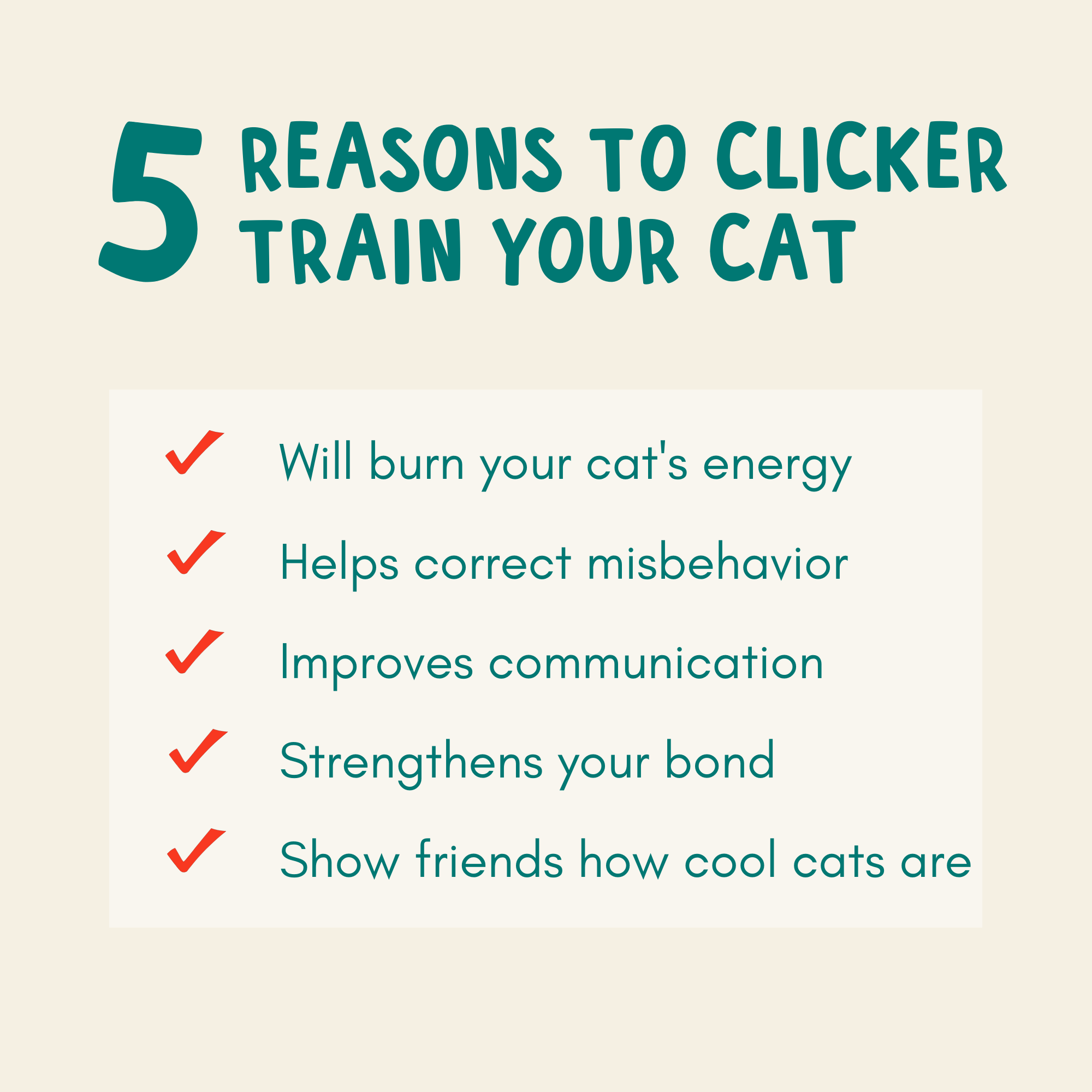
Clicker training is the process of using positive reinforcement (using a noise-maker called a clicker paired with treats) to teach a cat new behaviors, correct unwanted ones, and build clearer communication between you and your cat. 

It works on any breed, any age, and any personality, including your cat, which I'm sure you're convinced is "too stubborn" to learn. This guide walks you through exactly how to do it, starting from zero. You'll learn how clicker training works, what you need to get started, how to get started with your own cat, and how to move from basic obedience to more advanced tricks and behavior fixes.

But to me, what's even better than all that... training your cat will change how you and your cat understand each other.

Clicker training is a form of Positive Reinforcement (Operant Conditioning) that uses a secondary reinforcer to bridge the gap between the behavior that we want to see repeated and the reward for that behavior.

Because marking exactly the behavior with food is hard (the cat does lots of things all the time, and they won't know what it was that triggered the reward), we link the primary reinforcer (treat) with a secondary reinforcer (click sound).

By doing this pairing, which is called charging the clicker, the secondary reinforcer (clicker) will become as reinforcing as the primary reinforcer (treats). Think about money, for example: Money can not be eaten, provide shelter, or produce offspring, but we value money to the point that it shapes our behavior. Money is to humans what the sound of the clicker is to cats.

Also, I shot a full video nerding out on how clicker training works. If you like to learn why operant conditioning works, its origins, and everything in between, consider watching the video below:

How Do I Start Clicker Training My Cat?

Clicker training is the process of using positive reinforcement (using a noise-maker called a clicker paired with treats) to teach a cat new behaviors, correct unwanted ones, and build clearer communication between you and your cat. 

It works on any breed, any age, and any personality, including your cat, which I'm sure you're convinced is "too stubborn" to learn. This guide walks you through exactly how to do it, starting from zero. You'll learn how clicker training works, what you need to get started, how to get started with your own cat, and how to move from basic obedience to more advanced tricks and behavior fixes.

But to me, what's even better than all that... training your cat will change how you and your cat understand each other.

The process to train your cat with positive reinforcement is straightforward, but there are a few steps you must follow.

1. Charging The Clicker

Charging the clicker is the process of priming your cat with the knowledge that after a "click" comes a reward.

2. Foundational Skills

Not all tricks are created equal. Some cat tricks or obedience training are going to be harder than others.

There's a set of tricks, the foundational tricks that will enable your cat to learn other tricks faster and will become the foundation, hence the name, for everything else you'll teach after.

3. Basic Tricks

Once your cat understands the basics, you can start teaching your cat tricks. There's over a dozen tricks you can teach your cat without the need for shaping, but harder behaviors need to be broken down into multiple steps.

4. Shaping

Shaping is the process of dividing a particular behavior into different milestones. Each milestone builds on top of the previous one, with the intent of teaching your cat something that can't be taught sporadically, like jumping on your shoulder.

1. Charging The Clicker

When you first buy a clicker from a store, the clicker sound means nothing to your cat. Charging the clicker is the process of training your cat to understand that after a "click" comes a reward.

The process of charging the clicker is relatively straightforward:

  • "Click" then reward
  • "Click" then reward
  • "Click" ... you guessed it, then reward

How does this look in practice?

  1. Grab a bag of high-value and low-calorie treats. If you don't have low-calorie treats, you can break them down into smaller pieces. Grab your training clicker.
  2. Go into a room where your cat is comfortable.
  3. Settle down and press the clicker. After the "click", give your cat a treat immediately after.
  4. Repeat about 10 times.
  5. Do this every day for a week.

Cats should not eat more than 10% of their daily calorie on treats. Our recommended treats have about 2Kcal per treat, so that allows for about 10 treats per day. You can break them in half and do this session 2 times a day for 3 or 4 days.

After this first week, you will have built the expectation that after a "click" comes a reward.

Your clicker is officially charged and you can start training your cat using clicker training.

2. Foundational Skills

Not all skills are created equal. When you start teaching your cat tricks, you will be faced with the question of what to teach your cat first. This is where foundational skills come to play.

Foundational skills are those skills you can teach your cat that will open the doors for teaching new tricks and othe skills going forward. They may not be the most fun to teach or the most impressive, but they will give you and your cat a strong base on which you can build everything else.

Finger Targetting

This is the 1st trick you should teach your cat. It's the beginning of many tricks that will come afterwards.

Finger Targetting is taught using luring. As your cat approached the treat, move your index finger up and down. When your cat touches your index finger, click, then reward. Your cat is going to create the association between the index moving up and down and the treat.

hand holding a treat for clicker training cats

Place a treat between your middle finger and your thumb. Let your cat notice it.

As your cat approached the treat, move the finger up and down.

Hand holding a treat while teaching finger targeting to a cat

When your cat touches your index finger, click, then reward.

Your cat is going to create the association between the moving finger and the treat.

Cat looking at a finger going up and down

After a few repetitions, your cat will move towards a moving finger.

Continue clicking and rewarding when possible.

You just taught your cat to come on command!

Teaching Your Cat To Sit

Sit is also a very useful skill to teach your cat. May tricks start from a sitting position and mastering this skill will enable your cat to learn dozens of tricks after.

It usually takes a cat 1 or 2 sessions after the clicker is charged to learn to sit on command.

There are 2 ways to teach your cat to sit:

  1. Marking: All you have to do is capture your cat's sit by clicking and rewarding whenever they do it naturally. As you do that, your cat will increase the frequency of the behavior. While this is a successful way to teach it, adding a cue after is harder.
  2. Luring: My favorite way to teach a cat to sit on command. You get your cat to a sitting position using a treat and marking the sitting behavior when they do it. See below:
Hand with a finger pointing up

Place a treat between your middle finger and your thumb.

Hover a treat over your cat's head, and once they notice it, move it towards their tail.

Finger pointing up and a cat sitting

When your cat follows your finger, their butt will eventually touch the floor.

When that happens, "click" then reward.

Cat sitting on command

After a few repetitions, your cat will react to a finger pointing up. You can add a verbal command.

Continue clicking and rewarding when possible.

Sitting is the second most important trick you will ever teach your cat.

3. Basic Tricks

Now that we've nailed down the foundational skills, we can start teaching our cat tricks. Cats can learn dozens of different tricks.

Some of the first tricks I taught my Bengal cat Mia are:

  1. Come When Called
  2. Sit Pretty
  3. Spin
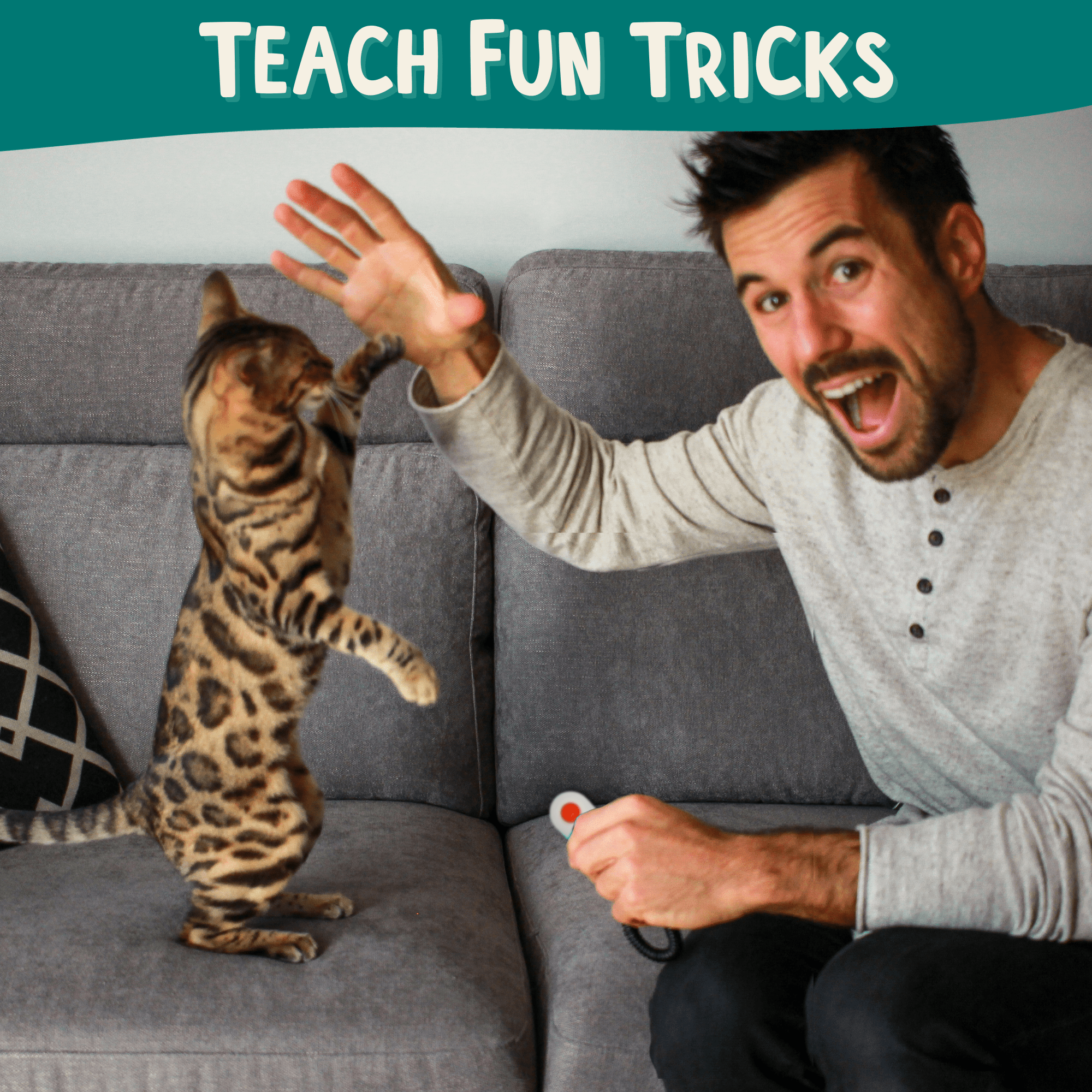
  4. High Five

These are some of the most popular tricks you can teach your cat, but the list is much, much longer. Cats have a great deal of intellectual capabilities, and when I started training Mia, I became obsessed with her ability to learn new tricks.

If you'd like to get a longer list of tricks and instructions so you can teach them to your cat, consider taking a look at the article below:

A man teaching tricks to a Bengal kitten on a green carpet

Teaching Tricks to Your Cat: 12 Tricks + How to Teach

Spray bottles only teach cats that you are scary. A retired vet showed me a silent signal that taps their hunting code. Cat behaviorists do this instead.

CAT TRICKS TUTORIAL

4. Shaping

In clicker training, shaping is a behavior-building technique where you reward your cat for successive approximations toward a final desired behavior. It's like stacking one trick after another to achieve a final goal.

For behaviors in which getting the full behavior to happen is hard (like jumping on your shoulder on command, or going through an agility course). You’re constructing it step by step, marking and rewarding small increments that move in the right direction.

Theoretically, this is what's happening:

  1. We get the cat to do a first step, click, and reward. That moment corresponds to a partial version of the target behavior
  2. We then build the next portion of the behavior, and get the cat to do step 1 and step 2
  3. We continue building steps towards the final desired behavior

Let's see it in practice, used on agility training:

Walk Over a Bar

We will place the jumping bar flat on the floor and lure the cat to walk over it. We'll "click", then reward.

Small Jump

We will raise the bar slightly, forcing our cat to lift their legs more than normal, even forcing them to do a small jump.

High Jump

We will raise the bar. Because of shaping, they will know to jump over the bar instead of crawling under.

What Do I Need?

You don't need much to train a cat. In fact, there are many learned behaviors your cat already exhibits that were taught with no tools at all. However, when using high-value treats or a clicker, or any of the other tools I'll share below, learning will happen more consistently and likely faster.

I will mention a free or cheap alternative to all the essentials below, so that you can train your cat even if you are on a budget.

1. A Clicker

The clicker is a mechanical noise maker. Some people call them crickets.

The story of the clicker is very curious. Clickers were used first as toys, then as a military tool so that paratroopers could locate each other without alerting the enemy (with a sound that would sound a little like an animal). B.F. Skinner, during his studies on operant conditioning and positive reinforcement, was the first to publicly use a clicker as a marker with a dog.

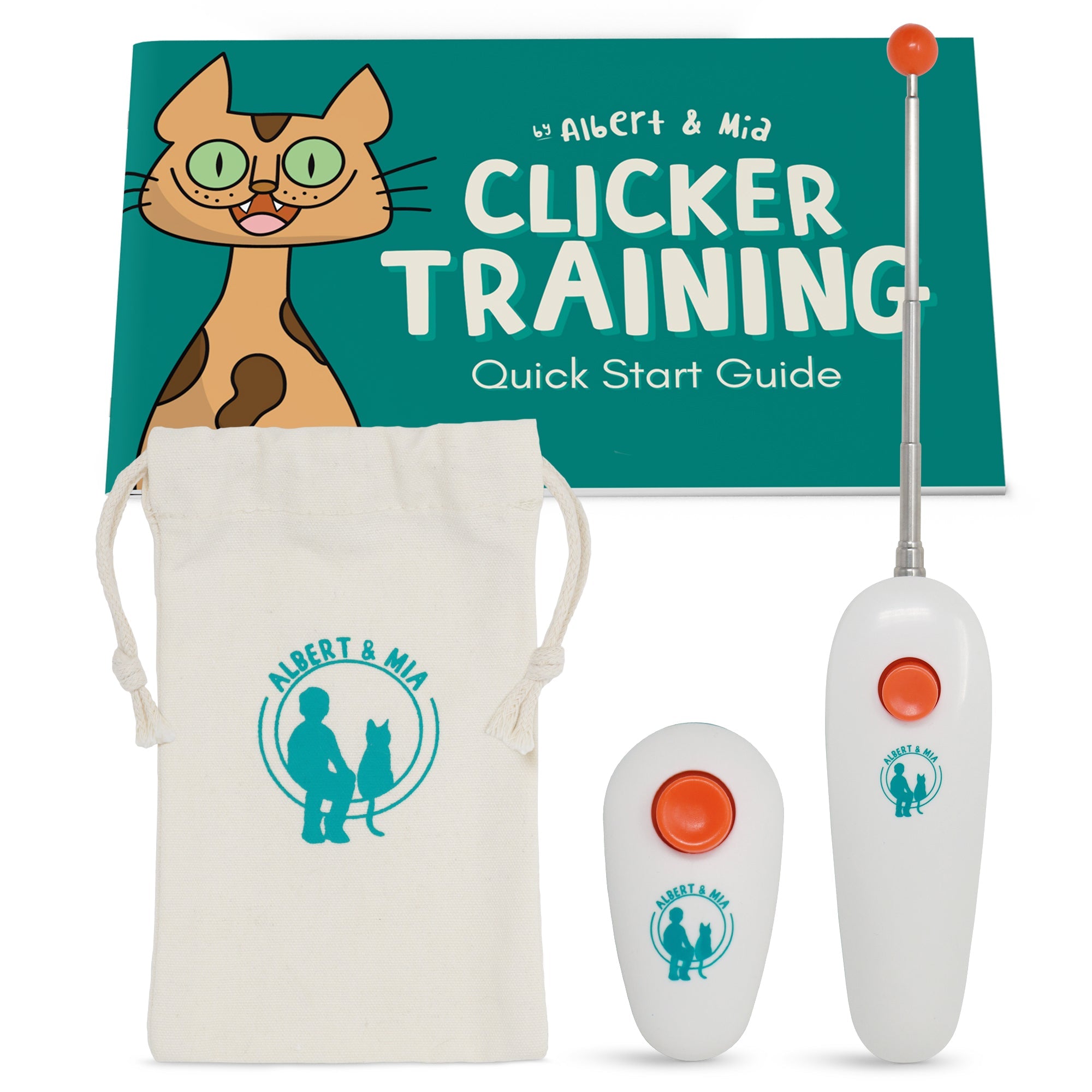
These markers are cheap, and they can be bought very cheaply on Amazon or at any pet store. There are more advanced options as well, designed specifically for cats, like the one on our Cat Training Starter Kit.

Clicker Training Starter Kit

Clicker Training Starter Kit

Clicker Training Starter Kit

Nothing beats clicker training to quickly train your cat!

✓ Quiet Clicker
✓ Target Stick Clicker
✓ Cat Training Quick Start Guide
✓ Treats Pouch

$ 29.99

Is a clicker needed to train a cat?

No, a clicker is not needed to train a cat, but it makes it much easier.

The objective of the clicker is to offer a different, consistent sound that your cat will link with training and nothing else. Any gadget or noise you can produce will serve that purpose.

Some trainers like using the word "YES" or "GOOD"; some will even snap their fingers. Whatever works for you, as long as it's a unique, different, and consistent sound.

2. A Jackpot Cat Treat

Treats are the currency we use to make training a win-win activity with our cats. It's important to find a treat that your cat goes crazy for. This is why we call this a treat, the jackpot cat treat.

While the clicker is important for clicker training, it is not as important as a treat that your cat won't be able to resist. Also, a treat that is nutritious and low-calorie will help you keep your training sessions healthy and rewarding.

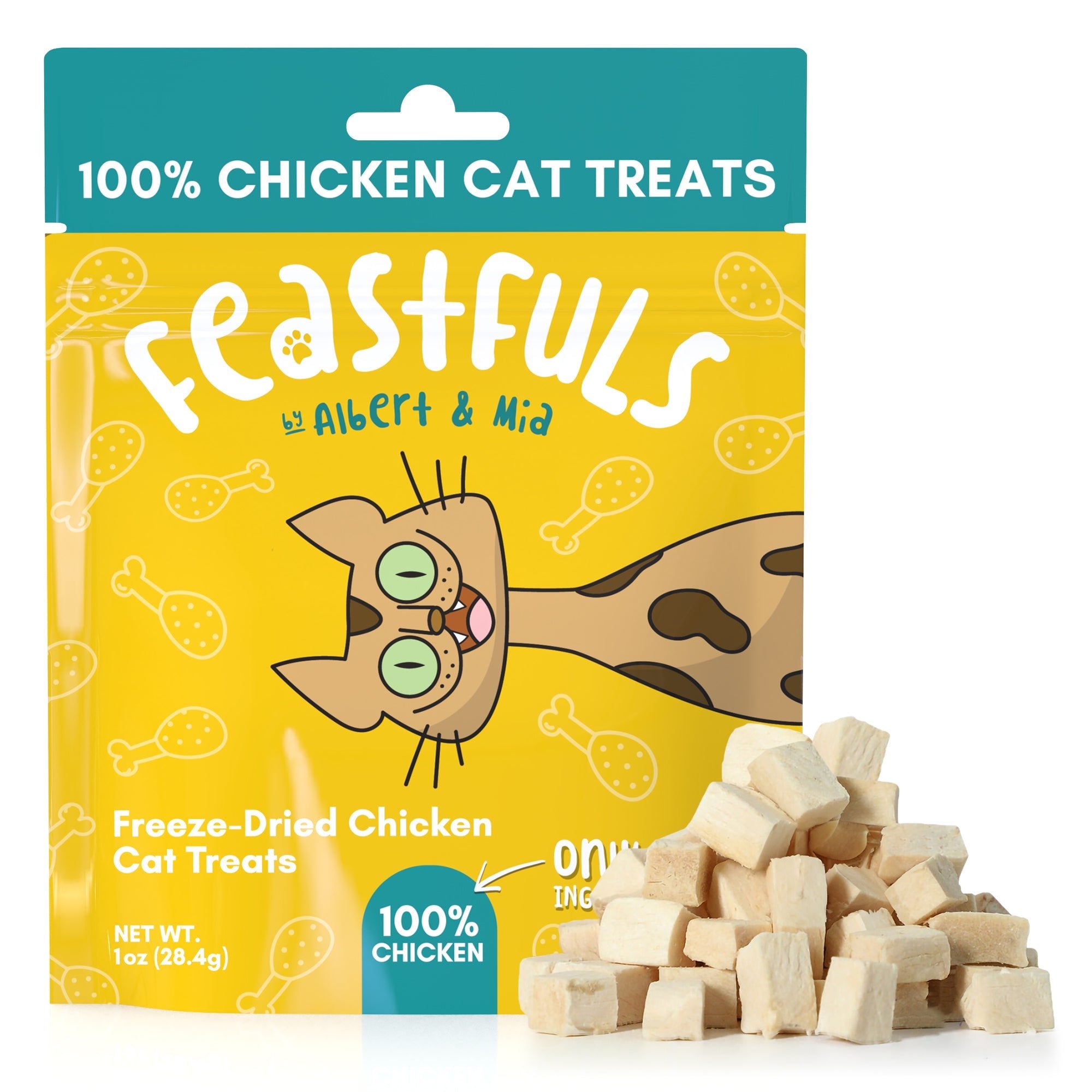
I recommend Feastfuls to train your cat. Here's why:

Feastfuls Cat Training Treats

Feastfuls™ - Natural Freeze-Dried Chicken Cat Treats

Feastfuls™ - Natural Freeze-Dried Chicken Cat Treats

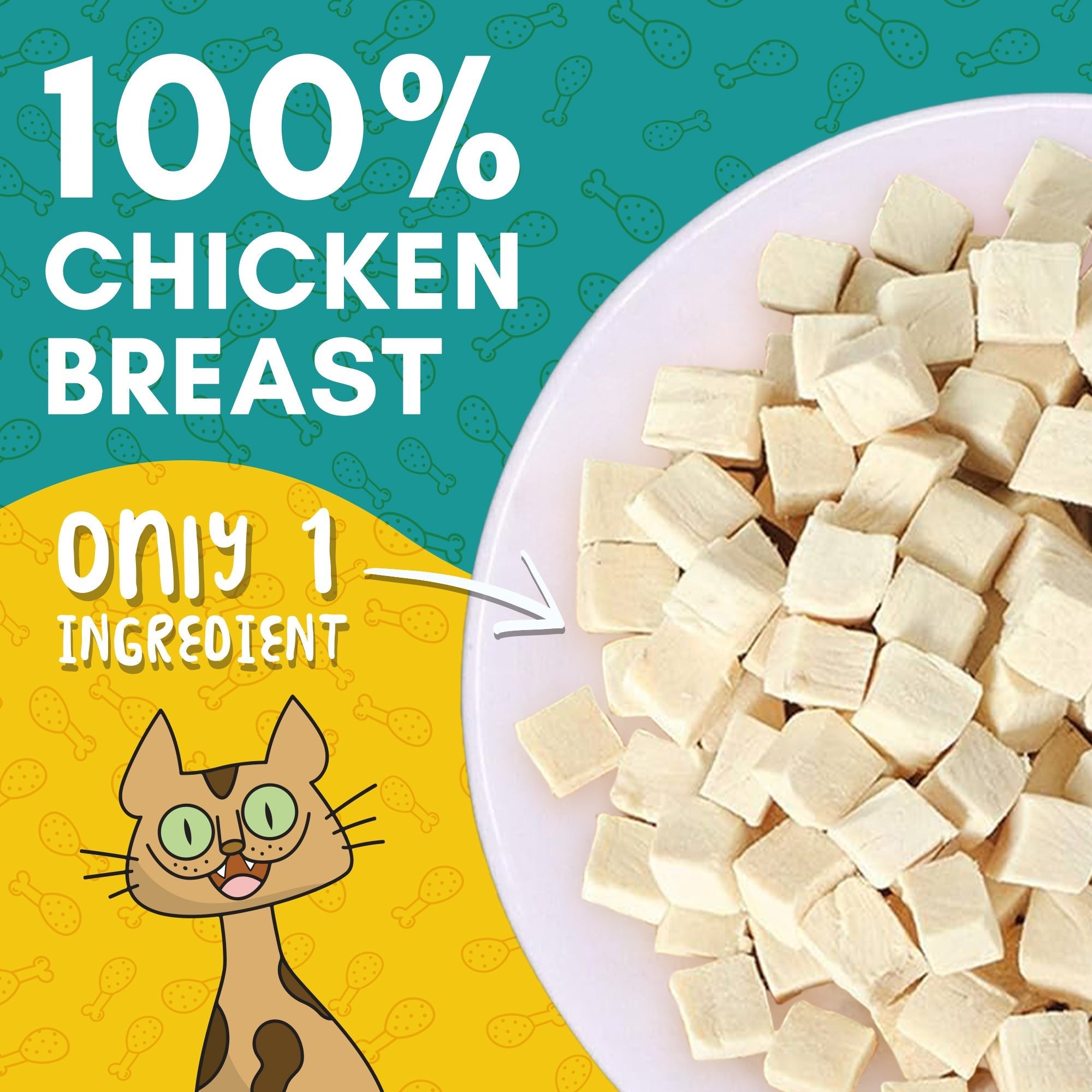
100% Freeze-Dried Chicken! Irresistible training treats.

✓ Great for cat training
✓ Small and low calories
✓ Single ingredient treats

$ 10.99

Imagine that after dinner, a friend comes to you and offers you a pizza if you complete a set of 20 pushups. How likely are you to even try to do the stunt?

Because we are going to be using food as a reinforcer, you will need two things:

  • Stop FREE Feeding your cat: If your cat has unlimited free access to food, it is going to be hard for them to value any treat you offer them because they are not going to be hungry at all.
  • Find a treat that your cat goes CRAZY for: We all have favorite foods, and your cat does as well. Freeze-dried chicken is a favorite, but it can be a little pricey. Get to know what works with your cat by trying different treats.

Sometimes I am asked how to train a cat that's not food-motivated. My take is that cats are programmed to be food motivated, so there's something wrong with that statement or the reasons causing your cat to not be motivated by the treats you are offering. There are a bunch of other tricks that will help you train your cat faster, but that's a topic for another day.

3. Patience & Consistency

One of the things I get asked the most is how long it takes to train your cat, and I think that this is the wrong question to ask.

Getting your cat to understand the foundational skills or even to learn basic tricks like sit can be done in 2 or 3 sessions. Clicker training has the benefit of making it very easy to shape behavior. 

Why do you need patience, then?

You will need patience because as you teach your cat more difficult tricks, your cat might take up to 30 or even 40 seconds to think, process, and execute a trick.

That does not mean that you don't need patience if you don't plan to teachhard tricks to your cat... Cat training is like being healthy, being fit, or being wealthy. It's not about the end destination; it's about the lifestyle and the choices you make every day.

Also, a cat that listens and behaves is a cat that has learned to look up to you for help when they face a new situation, or will make an effort to understand what you are trying to say at any given moment (they still might choose to ignore you, after all, they are cats).

Why Is It Important To Train Your Cat?

I was told since I was very little that dogs were hard work and cats were low-maintenance animals. They also told me that cats were independent and did not care about their owners.

Oh! Someone also told me once that cats were "kind of dumb and lazy".

It's crazy how much bad information there's out there. There's an historic reason behind "hating" cats in the Western world, but that's a story for another day. Luckily, none of that is true. Cats are extremely smart and trainable, and most misbehavior in cats has its origin in boredom and lack of mental and phisical stimulation.

Let's dig in:

Cats Will Appreciate Mental Stimulation

When paired with a primary reinforcer, usually food, training is going to be very much appreciated by your cat. In nature, your cat "works" for their food. Despite the work and reward in nature being different than training, your cat was designed to seek the reinforcement that comes from hunting.

Cats experience fewer emotions than humans, but studies have proven that they experience at least 6: 4 Main Emotions and 2 Predictive Emotions.

Main Emotions in Cats

  • Fear (Negative Emotion) - Threat immediately present, for example, a dog.
  • Frustration (Negative Emotion) - The Environment not meeting their needs, like not being able to get down from a tree.
  • Pleasure (Positive Emotion) - Enjoyable feeling, when eating or getting pets.
  • Relief (Positive Emotion) - Cease of discomfort, when a door that was closed is opened.

Predictive Emotions in Cats

  • Anxiety (Negative Emotion) - Anticipation of something fearful, like separation anxiety when you go on vacation or ride by car to the vet.
  • Anticipation (Positive Emotion) - Anticipation of something pleasurable, like when hunting to eat.

Dopamine is released in a cat's brain as a result of a feeling of eager anticipation.

Your cat's brain will release dopamine when hunting, just as they will release dopamine when training for treats or pets. These dopamine releases will make it less likely for your cat to feel bored, anxious, or depressed.

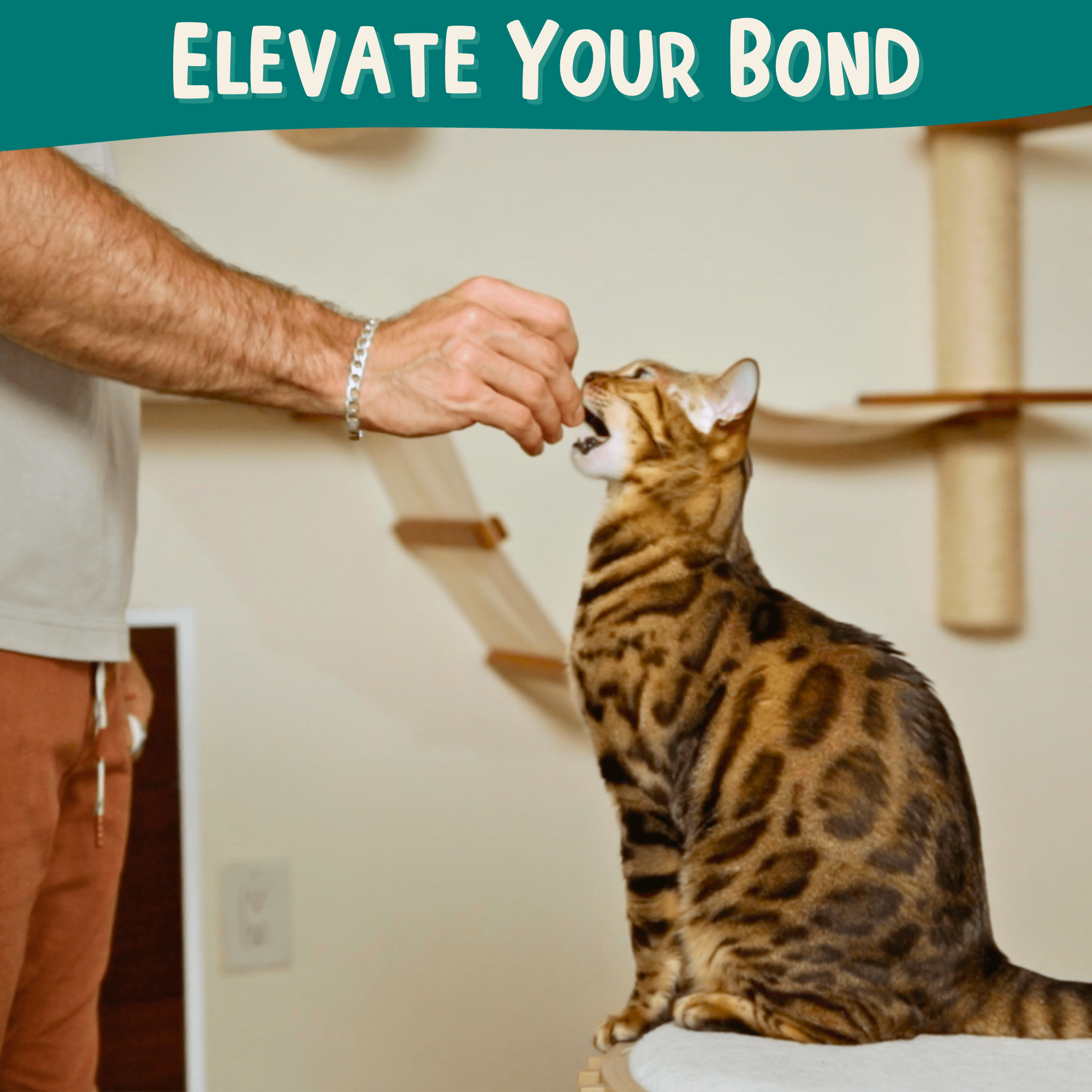
Training Your Cat is an Opportunity to Bond

By training your cat, they will learn to look up to you for directions. Training will make the feeding time a proactive activity on your end instead of a begging necessity for them.

Regardless of a cat's breed, size, or age, they can benefit from training.

Whether your training goal for your cat is to have a high-scoring obedience competitor or a well-mannered cat that knows the boundaries at home, a stronger bond will stem from positive reinforcement training.

We live busy lives, and even those working from home and spending loads of time with the cat, we don't spend much quality time with them.

Because cats appreciate routine, set aside a few minutes each day for formal training sessions.

Training is a moment on the day when both cat and human are paying full attention to each other.

In addition to clicker training, which is more formal, I consider every interaction with my cat as a training opportunity.

For example, during meal times, I like asking her if she's hungry. She meows as an answer. Then I asked her to come with me. She would definitely come anyway, but reinforcing that command every time I feed her a meal makes it that much stronger when I need her to come to me in a different setting, like walking on a leash.

Training Your Cat Will Help You Understand Them

Cats' subtle body language is most of what they use when they communicate with their species. They also use pheromones as an invisible secret language that only other cats can perceive.

Cats only meow as kittens as a means of communicating with their moms. Domestic cats consider us their caregivers, and they continue using their vocalizations as a means to call our attention and let us know what they need. The problem is that we don't have a language that they can understand; well, we do.

Today, there are two ways in which we can communicate with our cats:

Training your cat will give you the tools to speak a language your cat can understand. This, for me, is worth every minute I spend training my bengal cat, Mia.

Correcting Misbehavior

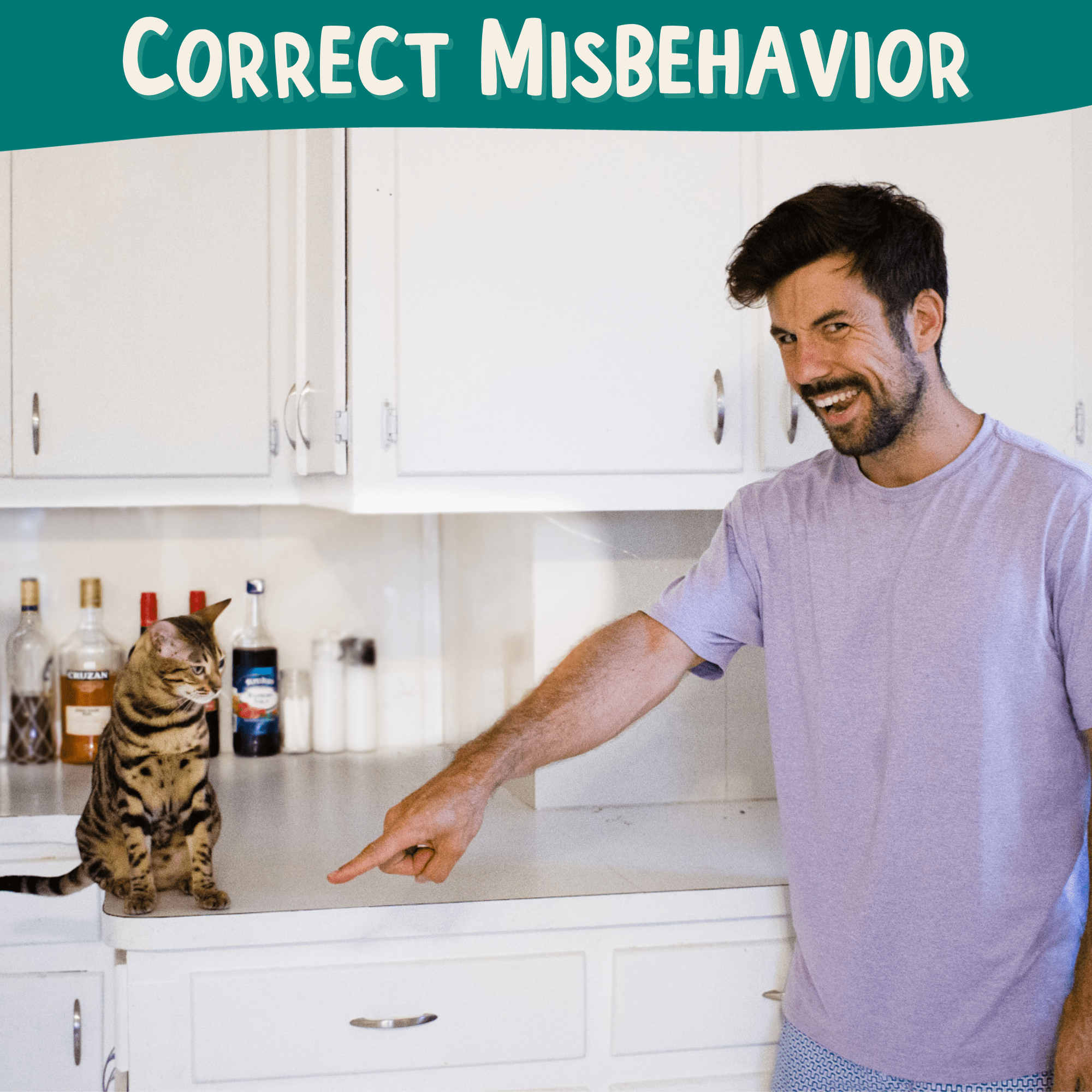
Once you've learned to speak a language your cat can understand, it becomes easier to encourage good behavior and discourage bad behavior.

If you are looking to shape your cat's behavior and punishment is not working, you are not alone. Discipline and cats are not done via punishment. The correct way of stopping misbehavior is to:

  1. Understand the root need
  2. Offer an alternative
  3. Reinforce the alternative

Punishing cats doesn't really work, but there's a system to discipline your cat.

Cat scratching red sofa

Instead of Using a Squirt Bottle, Correct Misbehavior at the source!

Spray bottles only teach cats that you are scary. A retired vet showed me a silent signal that taps their hunting code. Cat behaviorists do this instead.

CORRECTING CAT BEHAVIOUR

This is Why Your Cat Doesn't Listen

It is fairly common to get your cat to ignore you. This usually doesn't happen when there are no distractions, but when a noise, a new box, or a fly enters the room, forget about having your cat's attention.

Competing Stimuli in Cat Training

A reinforcer is anything that immediately follows a behaviour and impacts the frequency of that behaviour in the future. At any one time, there are numerous reinforcers available within your cat's environment.

Competing stimuli or competing reinforcers are elements that distract your cat from paying attention to you and your treats. They can be positive reinforcers (treats, birds, a toy, a box...) or punishing (a threat, pain...) 

Animals, particularly cats, always orient their attention towards the most reinforcing element in their environment.

When you take your cat outdoors, the change in environment offers different reinforcers (birds and bugs to chase), and consequently, the value of what we have to offer (treats) is decreased.

Get your cat very comfortable at performing tricks and listening to commands, and then try to incorporate competing reinforcers indoors. Try to automate your cat's reaction to your commands so that when there are competing reinforcers, they don't hesitate.

Diminished Food Drive

A diminished food drive directly constrains the efficiency of training. We use treats as currency, as a reward, to reinforce a behavior. When a cat is not hungry or interested in the treats we are offering, it weakens the primary reinforcement for our training.

In operant conditioning terms, if the reward lacks sufficient value, you lose motivation, cat's thinking time increases, and behavior becomes inconsistent or extinguishes altogether.

Increasing reward quality (higher-value treats, novelty, texture), and optimizing timing (training before meals) will be some of the tricks we use to increase food drive.

Can You Train a Cat to Walk On a Leash?

Absolutely! You can even train your cat to ride on a bike with you!

To teach your cat to walk on a leash, we are going to use positive reinforcement. We are going to pair the harness and all harness experiences with something good: treats or playtime.

It's a fairly simple process that, if taken with patience, will be extremely rewarding for both you and your cat.

Harness Training Cats

The #1 thing you must understand before getting your cat inside a harness is that a harness will be perceived as a foreign object, because it is. Our responsibility is to make this introduction as easy as possible so that our cat accepts the harness.

Start by choosing a light and comfortable harness. We always recommend the Houdini harness to start, as it's our safest harness. Once your cat is comfortable wearing it, you can upgrade to the Always On, which is a bit less secure but more comfortable.

Black and white illustration of a cat smelling a cat harness

Cats use scent to mark objects and places they trust. These little scent marks are called pheromones.

By letting your cat explore the harness on their own, they get scent marks that will make wearing it comfortable later on.

Cartoon cat sitting on a brown chair with a white background

After a few days, your cat will have impregnated the harness with pheromones, and you can try placing it on them for the first time.

Do not rush it and do not tighten the harness at first. Put the harness on and reward.

Cartoon cat with a black stripe on a white background

Only after your cat is comfortable wearing the harness indoors can you consider tightening it and start practicing with the leash.

Move slowly during this process. Developing trust towards the harness makes everything else easier going forward.

As you can imagine, there's a lot more to harness training your cat, but these are the basics to get you started.

If you'd like to get a more thorough overview of what harness training is but also are curious to understand how to deal with the litterbox when traveling, how to get your cat comfortable on a car, how to pack for a trip...

You came to the right place!

Adventure Cat Training Guide

Whether you're preparing for your first backyard stroll or envisioning mountain trails, this guide will help you and your cat take the first confident steps beyond the front door.

I WANT TO TAKE MY CAT ON ADVENTURES

Stay Wild, Stay Safe, See You Outdoors!

Albert & Mia